IGCSE ART CLASS 10 PORTFOLIO
FLOWERS AND FOLIAGE
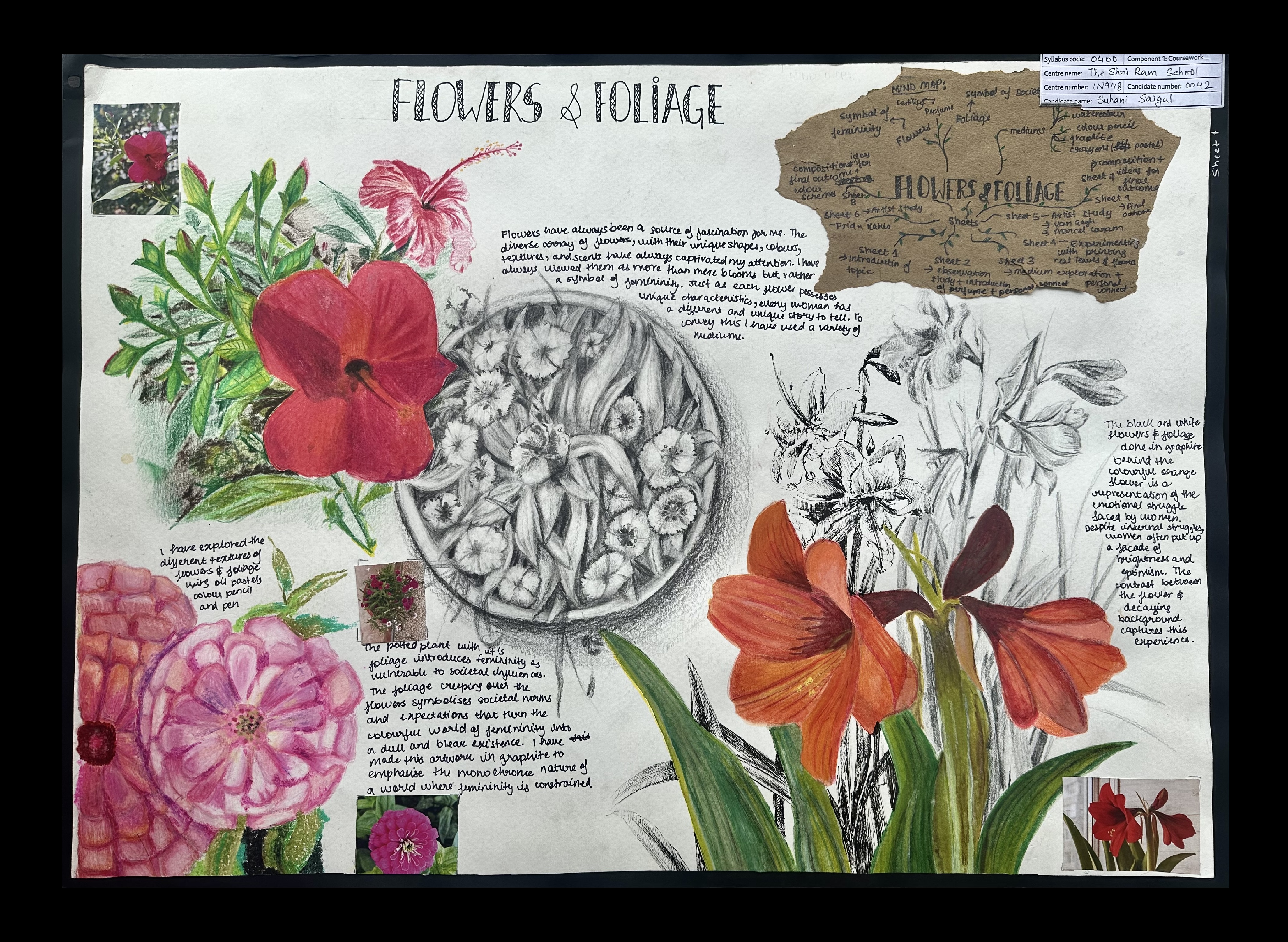
SHEET -1
Since childhood, I've been captivated by the diverse array of flowers, and their unique shapes, colors, textures, and scents. To me, they symbolize femininity, with each bloom representing a woman's distinct characteristics and story. To portray this diversity, I've utilized various mediums, including graphite, colored pencil, oil pastel, watercolor, and pen. The image of a potted plant with its foliage encroaching upon the flowers reflects how societal norms can stifle the full expression of femininity. This intrusion threatens to dull the vibrant world of femininity, an idea emphasized through the use of monochromatic graphite. The contrast between a vivid orange flower and the somber black-and-white drawings behind it illustrates the emotional struggles women face, often masking inner turmoil with a facade of brightness.

SHEET -2
The multi‑layered watercolor flowers bring out femininity’s essence, especially fertility, as they bloom and pass life onto new buds. Surrounding foliage symbolizes the supportive aspects of society that help women flourish and transmit their essence to future generations. By contrast, the gouache leaves present a sector of society resistant to change, clinging to outdated values and devoid of substance. A perfume bottle introduces the idea of femininity’s captivating power, and how a woman can spread her essence and share her strength with others. The bottle itself is rendered in black‑and‑white pen‑hatched lines, while the liquid is painted in watercolor to emphasize that true strength lies in the unique essence, not the vessel.
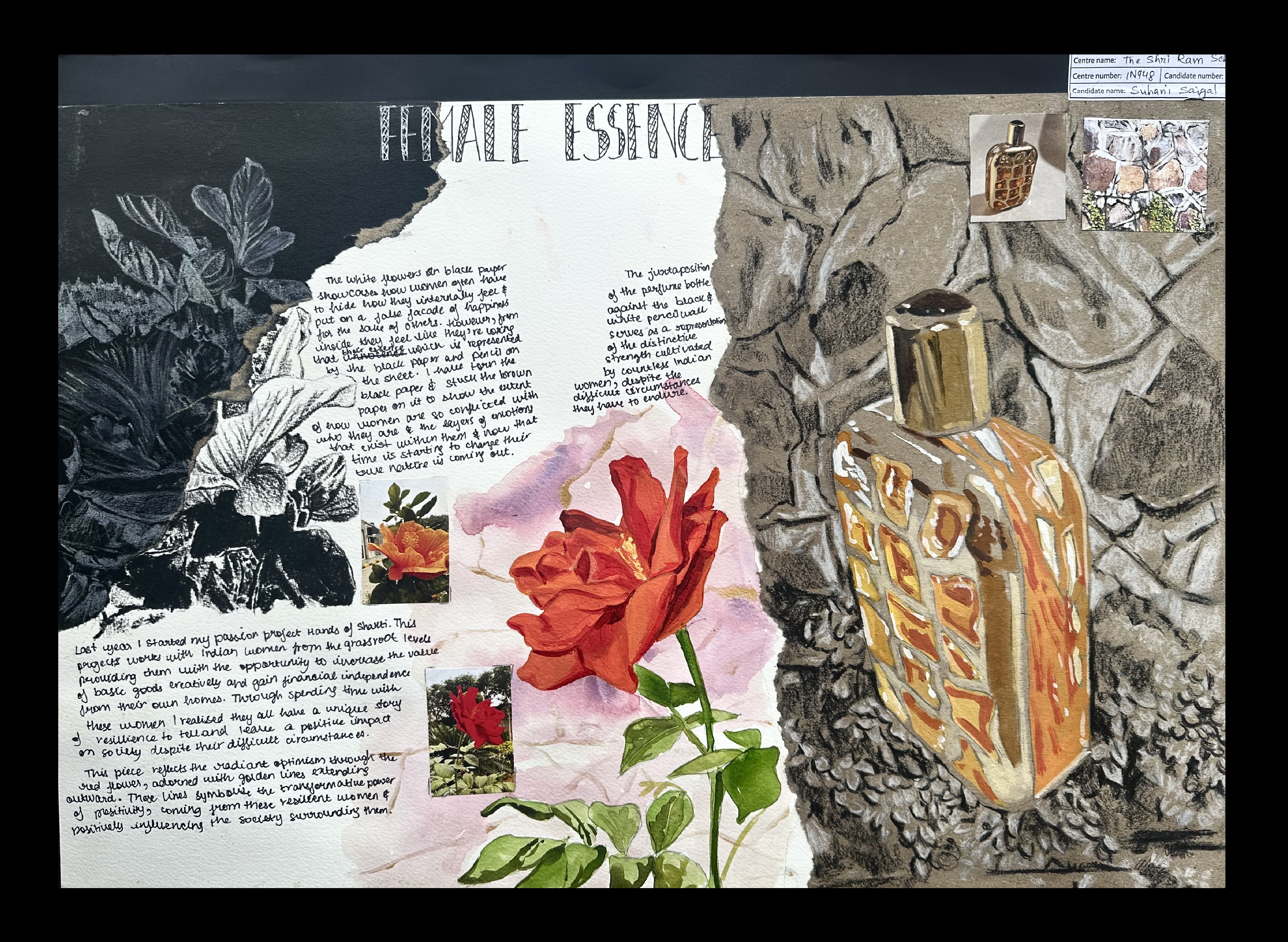
SHEET -3
‘Hands of Shakti’, an initiative that I launched last year, empowers Indian women to gain financial independence by applying their creativity to create unique, beautiful products that enhance everyday goods. Through working closely with these women, I witnessed their remarkable resilience and radiant positivity, embodied in a red flower with golden rays. These rays symbolize how their uplifting influence lightens even the darkest parts of their communities. The stark contrast of a pen‑hatched monochrome wall and a colorful perfume bottle illustrates the deep inner strength these women maintain amid adversity. White flowers on black paper reflect their hidden emotions behind a façade of happiness, while black pencil on white paper reveals a loss of essence beneath the mask. Finally, torn black paper patched with brown portrays their conflicted identities and the emotional complexity gradually emerging as times change.
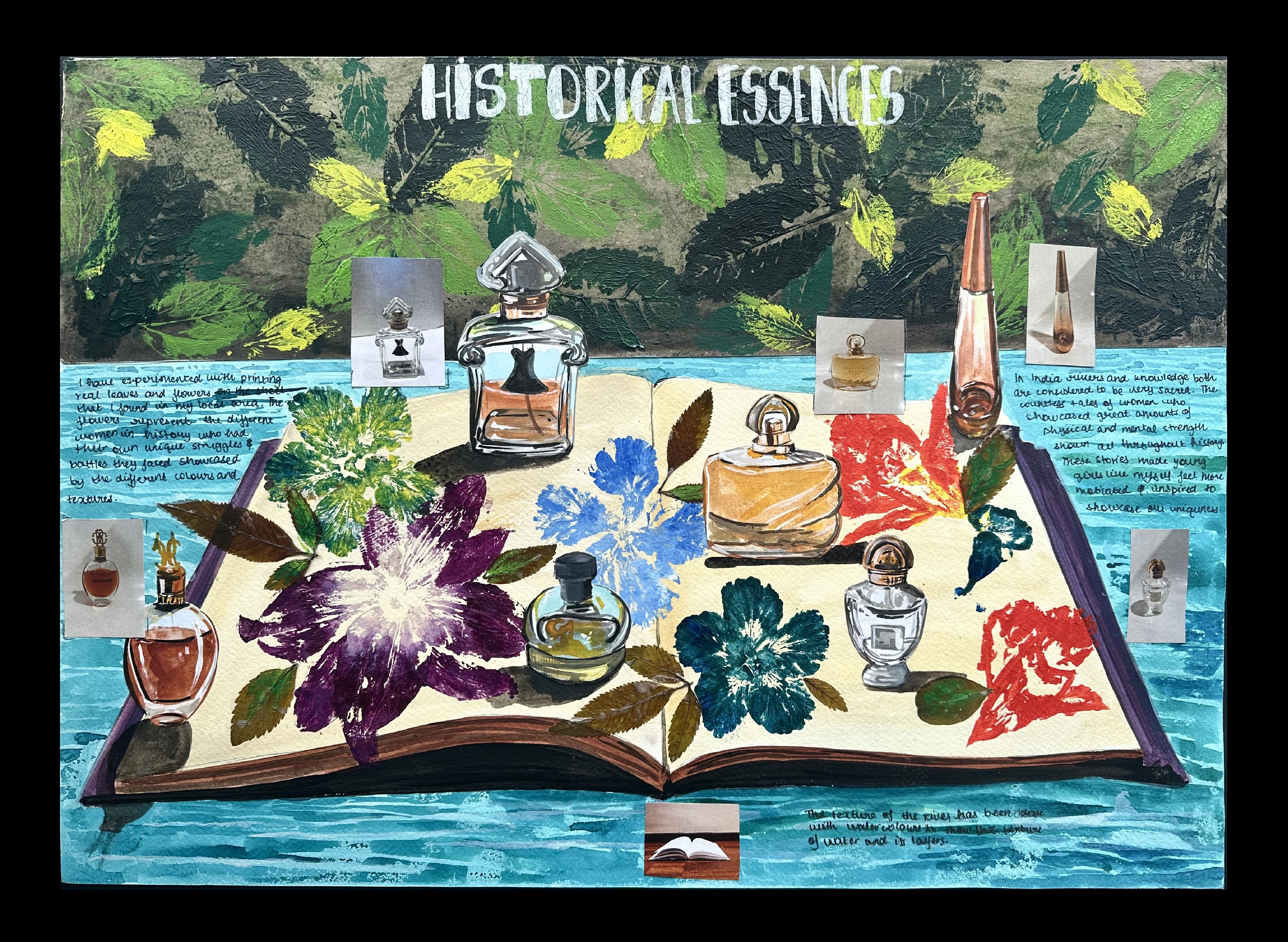
SHEET -4
In India, rivers and knowledge are both deeply sacred, weaving into cultural narratives that honor women’s strength throughout history. Tales of women demonstrating remarkable physical and mental resilience have inspired young girls like me to embrace their own uniqueness. The perfume bottles in my work symbolize that inherited strength passed down through generations. I experimented with printing real leaves and flowers found locally, using their distinct colors and textures to represent different historical women and the unique battles they faced. By arranging the colored leaves into floral shapes, I highlight how Indian society is evolving into a more inclusive space for women’s self‑expression.
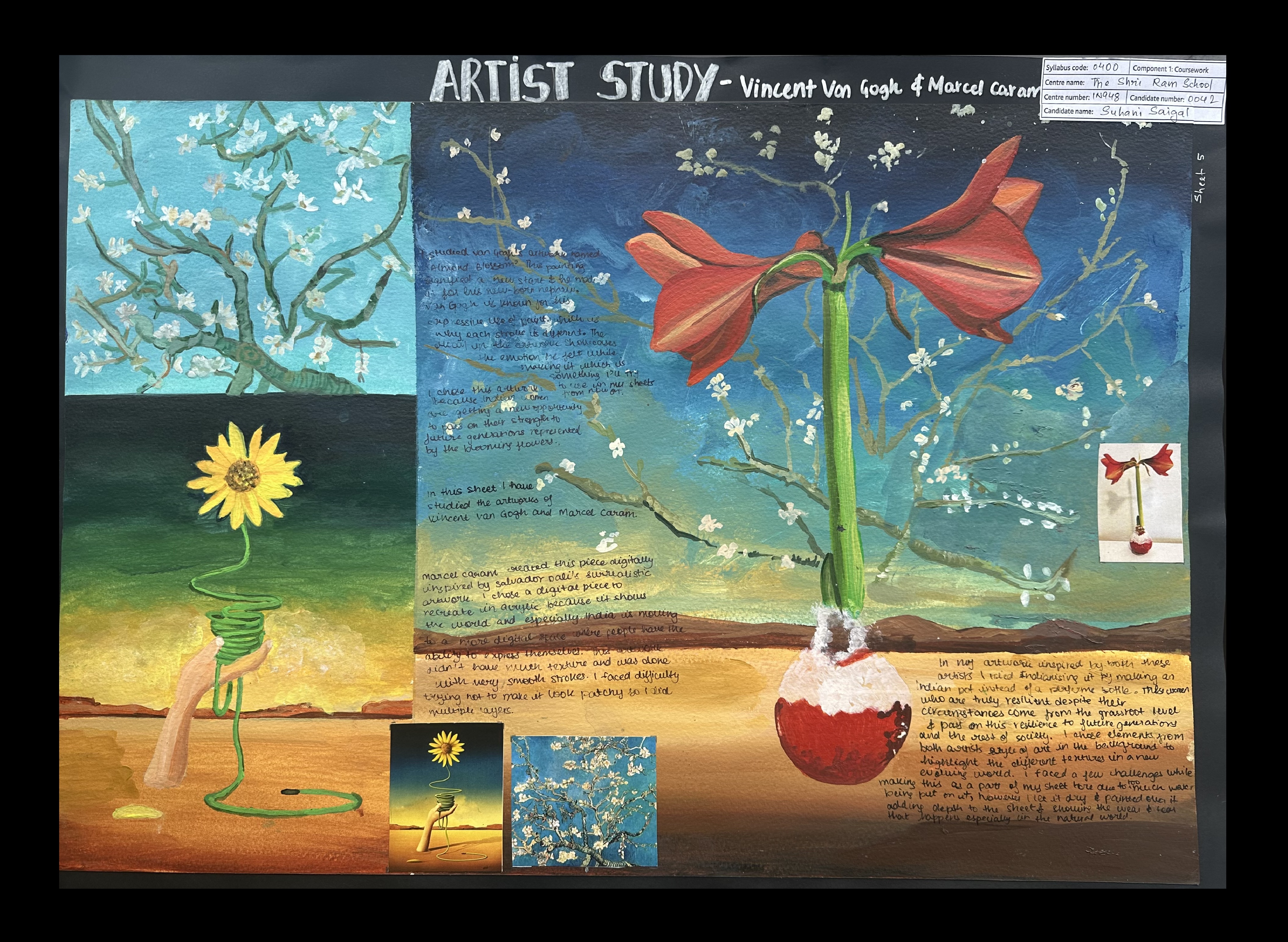
SHEET -5
In one of my chosen digital artworks by Marcel Caram, I was inspired by Salvador Dalí’s style to depict the hand as a symbol of the growing support women in India receive in an increasingly digital world, enabling them to bloom and embrace their full selves.
The second artwork I chose was Vincent van Gogh’s ‘Almond Blossom’, painted to celebrate his newborn nephew. The work symbolises renewal, and mirrors the new opportunities Indian women now have to pursue their dreams and pass on strength to future generations, like blooming flowers. In my reinterpretation, I varied the brushstrokes, some thick, some thin, and emphasized detail in the trunk and blossoms to evoke the emotional intensity van Gogh expressed, an approach I carry forward in my own work.
I used acrylic for all the artwork in both artist studies, as it allowed me to closely replicate their original styles while incorporating Indian elements, like replacing the perfume bottle with a traditional Indian pot. This pot represents the strength of grassroots women who, despite their hardships, pass on both tradition and feminine authority; while the changing background scenery and an accidental tear from excess water adds unexpected texture and depth to the final piece.
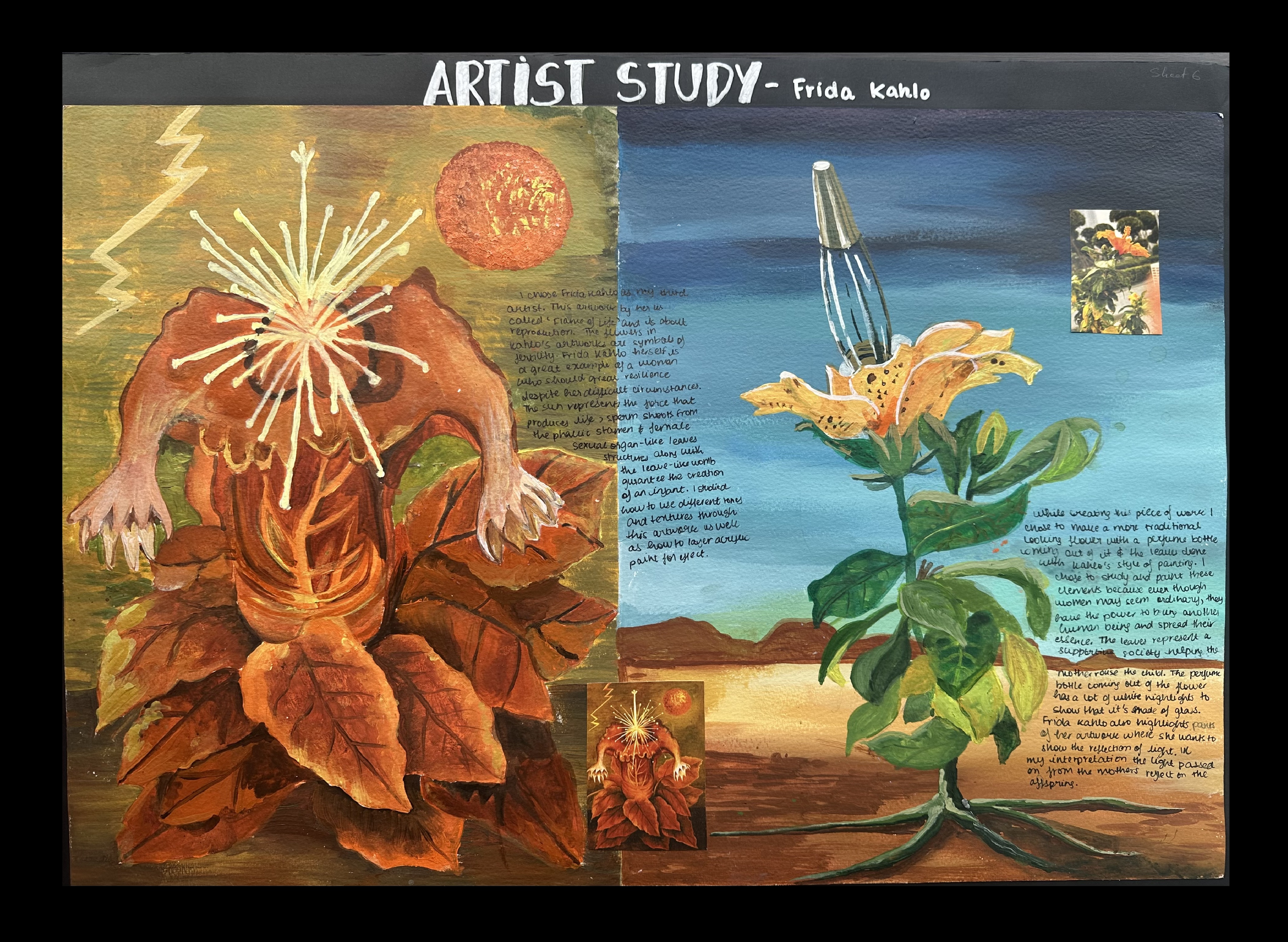
SHEET -6
Frida Kahlo, who remained resilient through significant personal hardship, created ‘Flame of Life’ to represent reproduction. Its flowers symbolise fertility, the sun a life-giving force, and female-organ-like leaves form the womb that receives sperm from a phallic stamen. While recreating this artwork, I learned to skillfully layer acrylic paint and use lighter colors for highlights, which added depth and vibrancy. In my interpretation, I painted a more traditional-looking flower with a perfume bottle emerging from its core, and used similar leaves to echo Kahlo’s style. I chose this motif because, although women may appear ordinary, they possess the power to bring new life into the world and spread their essence. The leaves in my piece represent a supportive society that helps mothers raise their children. The white highlights on the bottle symbolize the light mothers pass on to their offspring, reflecting Kahlo’s own use of lighter colors.
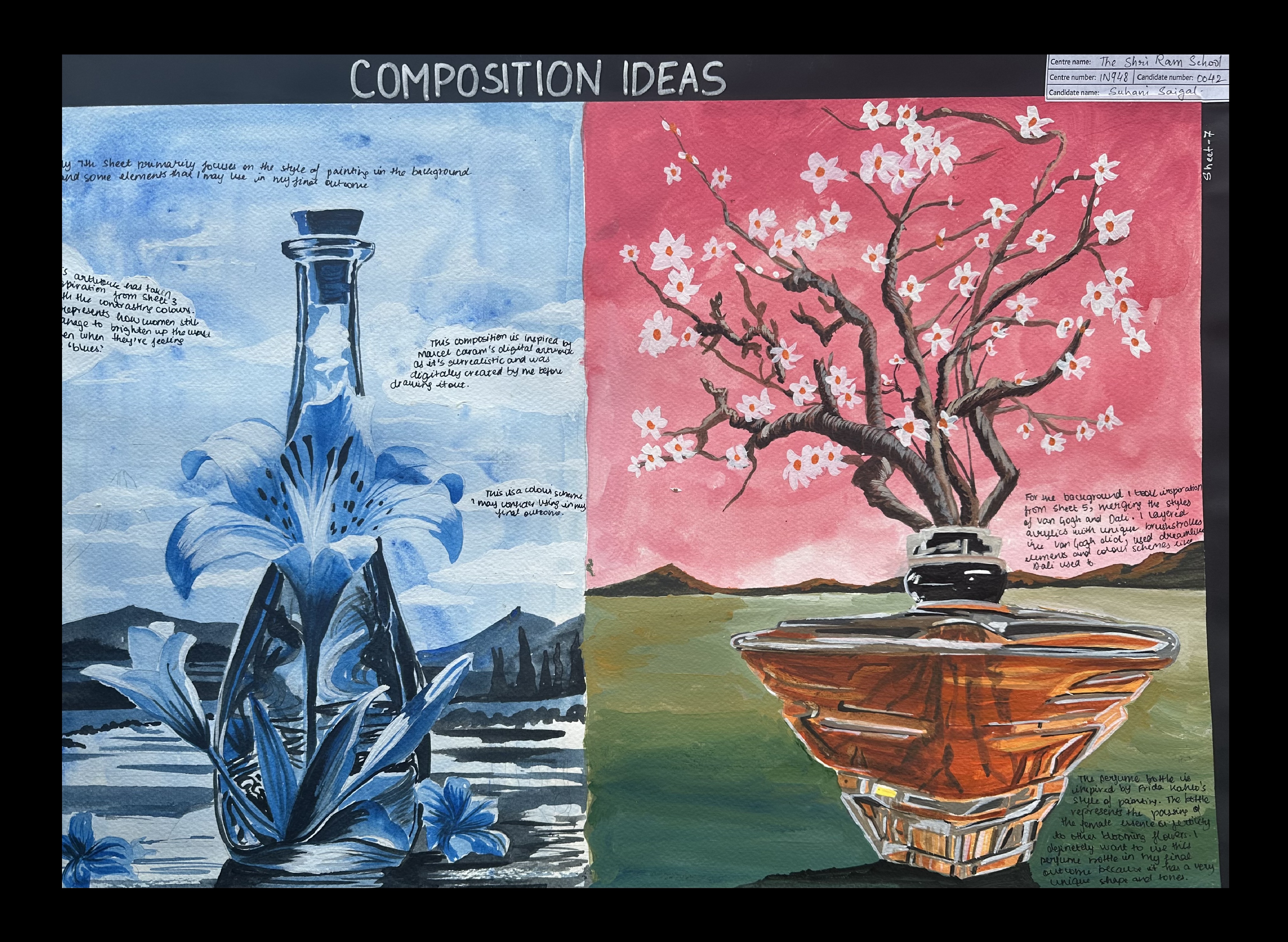
SHEET -7
This sheet, focusing on background, colour schemes, and key elements for my final outcome, reflects inspiration from all four artists—Marcel Caram, Vincent van Gogh, Salvador Dali, and Frida Kahlo. The artwork in blue tones, influenced by Marcel Caram’s digital style, was first created digitally, and then painted with watercolours, allowing smooth layering and effective shadow detailing. Drawing from Sheet 3, the contrast in colours represents how women, even at their lowest, still manage to brighten the world with their blossoming essence. For the second artwork’s background, I was inspired by Sheet 5, merging Van Gogh’s textured brushstrokes with Dali’s surreal, dreamlike elements using layered acrylics. Finally, echoing Frida Kahlo’s influence, the perfume bottle symbolises feminine essence and fertility, while the flowers growing from branches represent the passing down of femininity, something I aim to include in my final outcome.
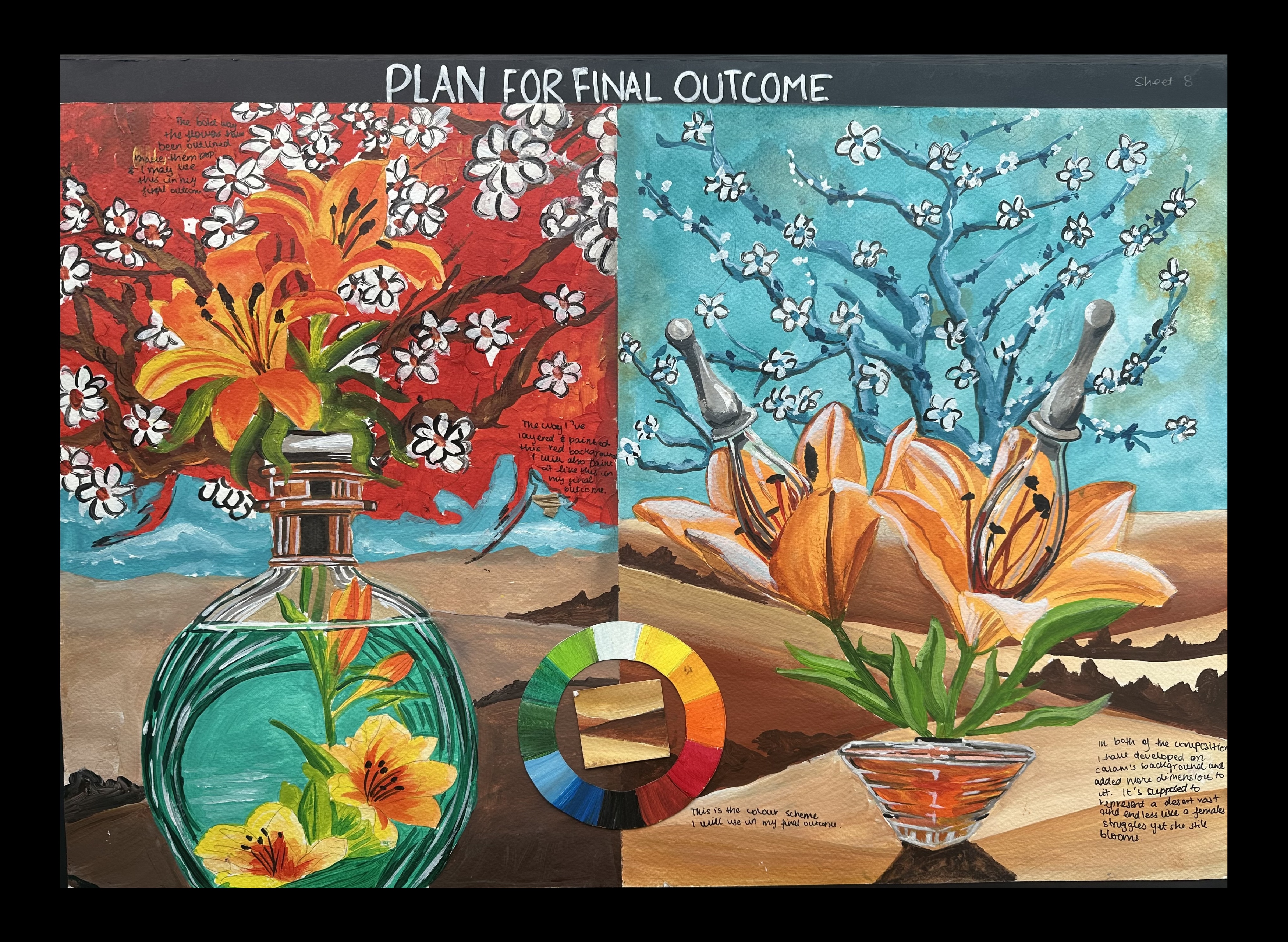
SHEET -8
In both of the compositions, I have developed on previous colour-based explorations and added new symbolism to refine what I wish to represent. The perfume bottle on the left, with enclosed yellow lilies, reflects inner vibrancy, while a red background with blooming white flowers evokes strength emerging despite emotional weight. The mirrored composition on the right extends this idea; the lilies bloom freely outside the bottle, and the almond blossoms, inspired by van Gogh, reinforce the idea of renewal. The droppers inside the open petals symbolise how feminine essence isn’t confined, but rather poured out into the world, nurturing it. The presence of the traditional Indian bowl grounds the artwork in cultural identity, while the shift from red to blue backgrounds expresses emotional movement, from resistance and fire to clarity and openness.
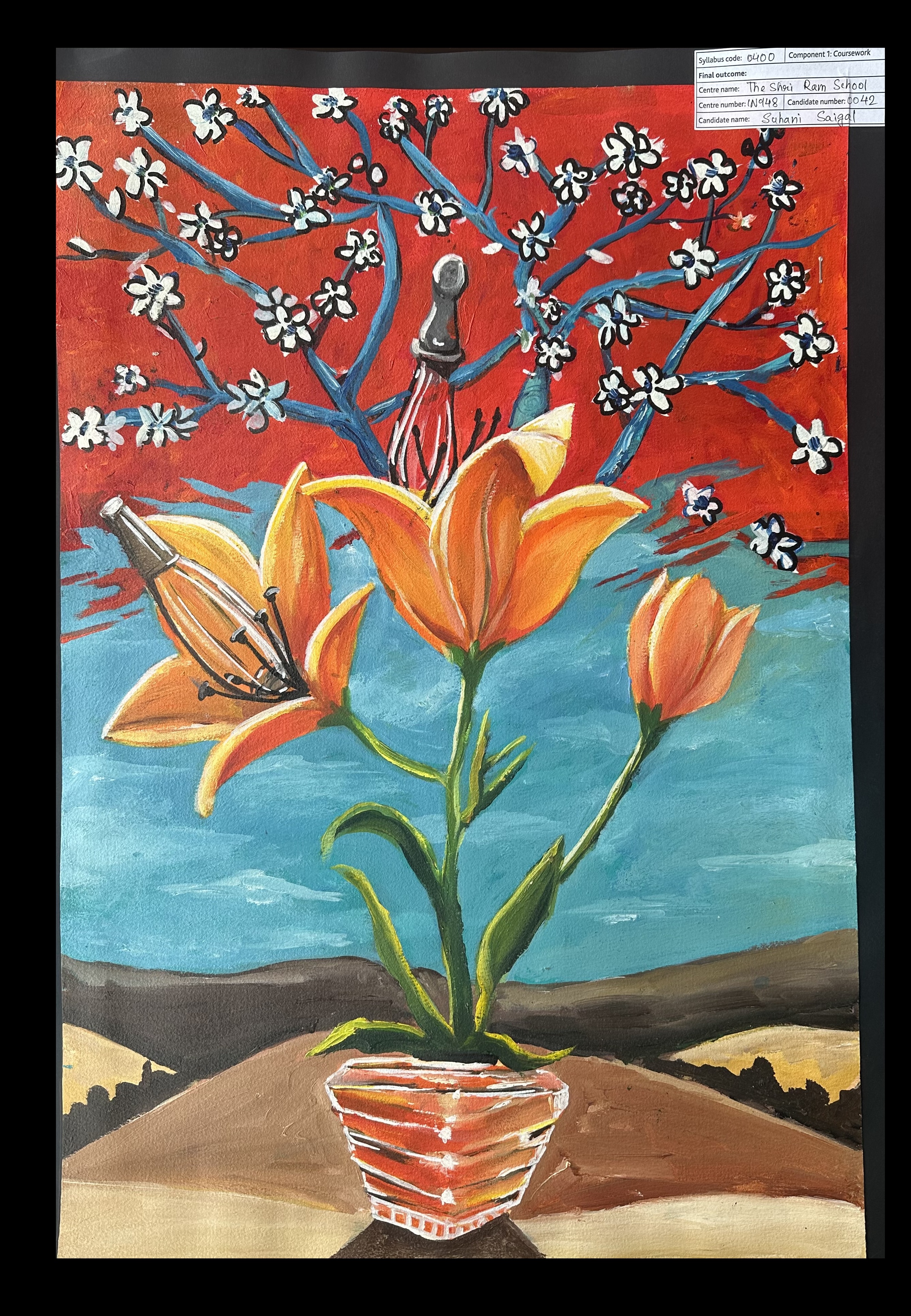
SHEET -9
This final piece brings together all the visual and symbolic elements I’ve explored across my previous sheets, creating a culmination of my ideas around femininity, resilience, and generational strength. The blooming orange lilies represent the emergence of feminine power, no longer enclosed but standing tall in open air, each petal carefully shaped to reflect uniqueness. The almond blossoms, inspired by van Gogh, now appear against a fiery red background, suggesting that even amidst emotional intensity, growth and renewal are always possible. The traditional Indian bowl acts as both vessel and anchor, symbolising how women ground their strength in tradition while still blooming beyond it. The pipettes emerging from the lilies carry forward the idea of spreading essence and nurturing strength, echoing the motif of the perfume bottle in earlier works. Set against a surreal yet grounded landscape, this piece encapsulates the journey of feminine essence, from containment and quiet resilience to vibrant expression and collective transformation.
REPAIR AND MEND
CHILDHOOD ‘JUGAADS’
SHEET -1

DETAIL WORK WITH STITCHING ON PAPER
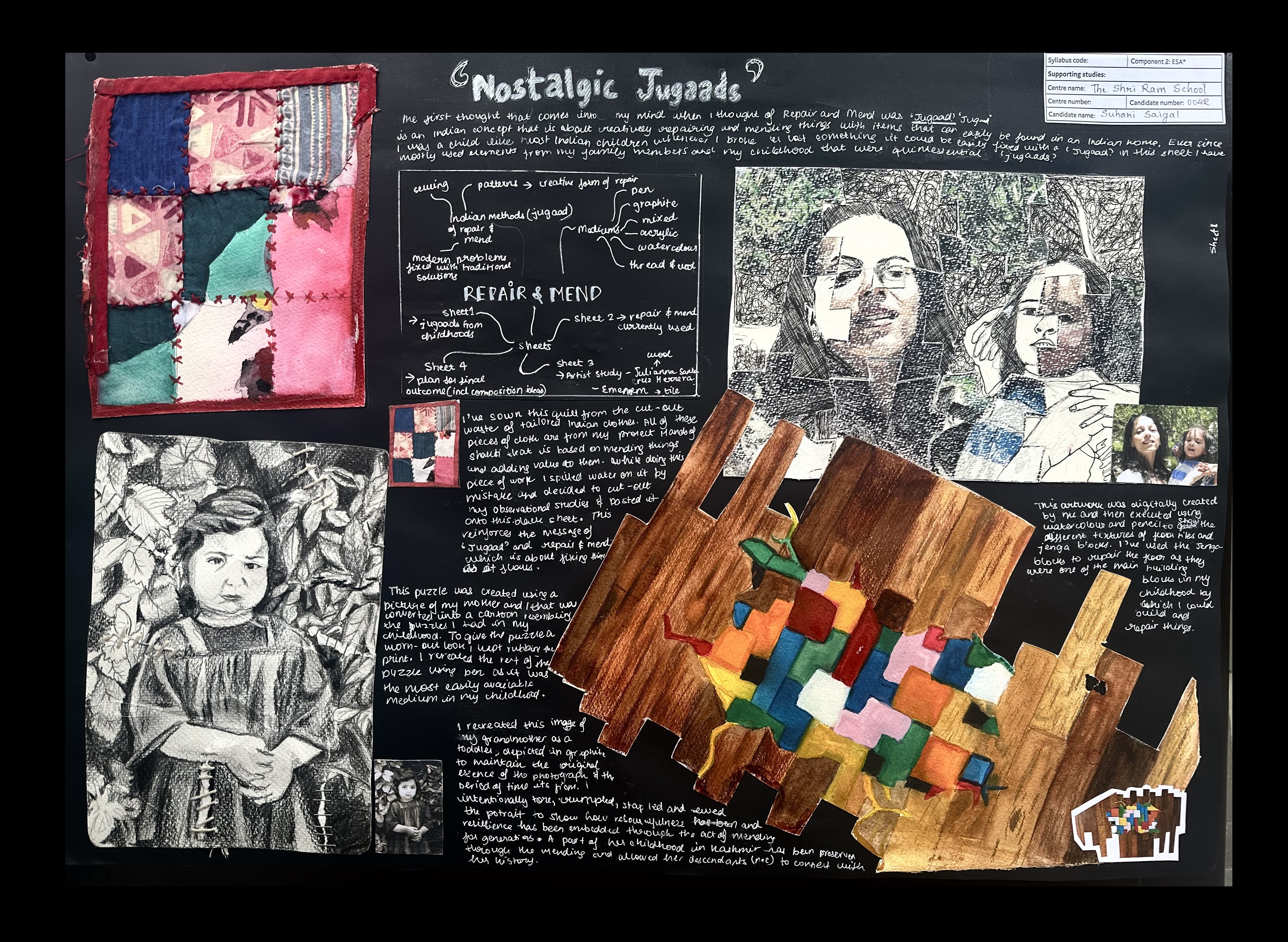
The first thought that came to mind when I considered the theme repair and mend was “Jugaad,” the Indian concept of fixing something at home using low-cost items, which I learned to do as a child. In this sheet, I’ve incorporated elements from my childhood, and broken items I repaired using remembered Jugaads.
I created a childhood-style puzzle featuring a cartoon sketch of my mother, an artist who taught me creative repair; and myself, manually aging the printed image by rubbing it to look worn, with parts of the puzzle hand‑drawn using a ball‑point pen.
I also recreated a graphite portrait of my grandmother as a baby in Kashmir, and intentionally tore and stapled the image as a symbolic act of Jugaad, weaving a narrative of resourcefulness and generational resilience rooted in a tradition that predates her childhood.
The mini quilt I sewed, tore in half, and then recreated using watercolours, references the Indian tradition of quilting, mending torn cloth pieces from different attires into one. I creatively composed on the torn black sheet from an accidental spill.
After digitally creating this artwork, I executed it using watercolor as a base, and colored pencil to simulate floor tiles. I incorporated Jenga blocks, which I used as a child to repair things, as symbolic tools to fix the floor in the piece.
SHEET -2


DETAIL WORK WITH STITCHING ON PAPER
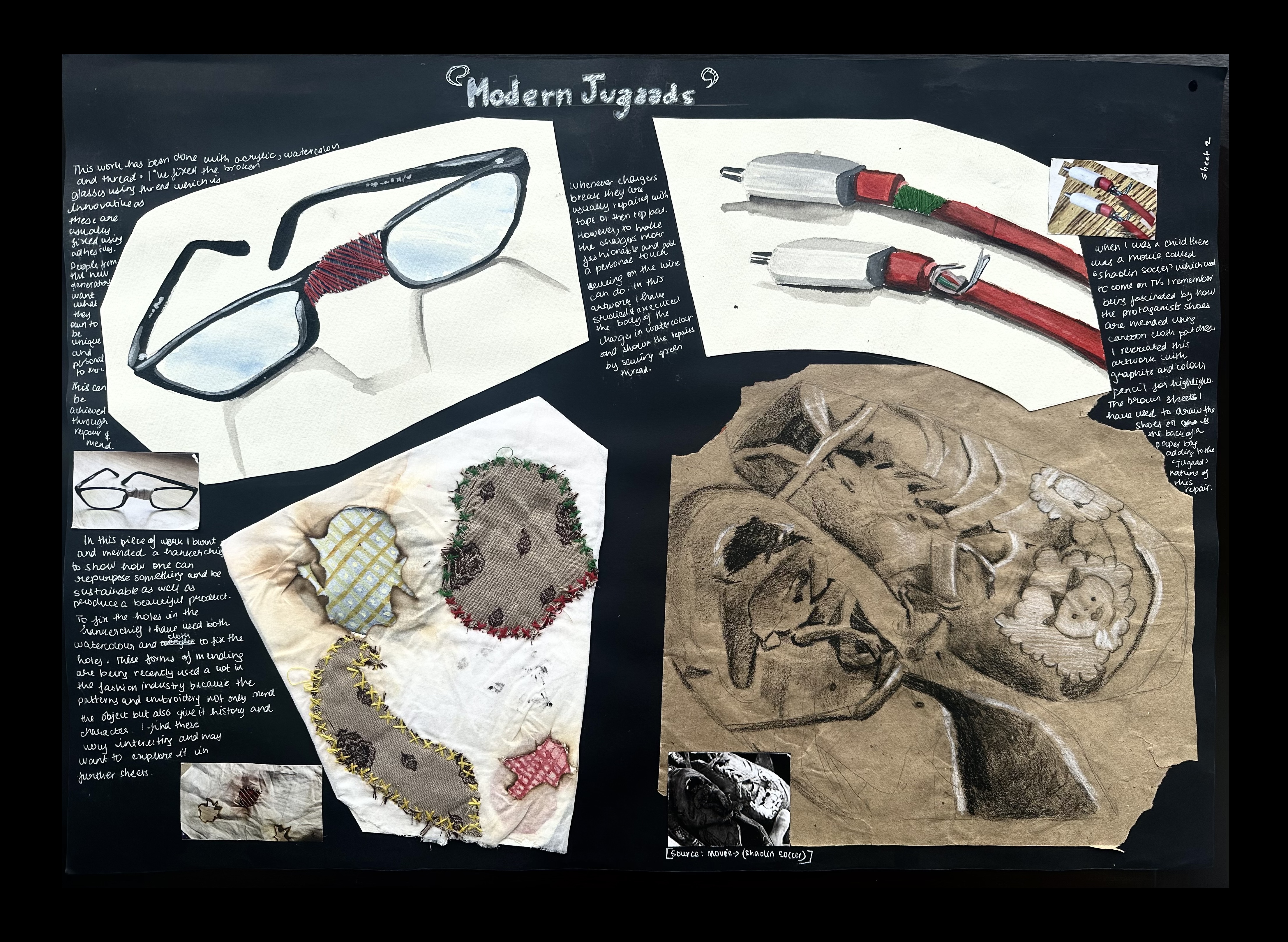
This sheet builds upon the generational theme of “repair and mend” by exploring how the idea of Jugaad has evolved in modern contexts. I began with a memory of using thread to mend my broken glasses, a quick fix that became a daily symbol of resilience; painting this in acrylic and watercolour to reflect both realism and sentimentality, overlaying text to contextualize the moment.
Beside it, I rendered AV cables repaired with matchsticks and wire, a personal recollection of how everyday technology in our home was extended beyond its lifespan using small, ingenious hacks. These were painted in gouache and pencil, with a real image reference to anchor their authenticity.
To contrast physical repair with textile restoration, I created a hand-stitched composition using worn fabric, embroidery, and sequins. Each patch symbolises fragments of identity stitched together, a tactile memory of traditional Indian repair methods, now applied to modern garments.
Finally, I recreated a graphite drawing of a worn-out shoe containing a child’s toy, referencing my own pair from childhood. Drawn on torn brown paper and stapled back, this piece symbolises how utility and sentiment overlap, how we extend the life of things we love, not just for function, but for emotional continuity.
SHEET -3


DETAIL WORK WITH WOOL ON PAPER
COLLAGE DETAIL
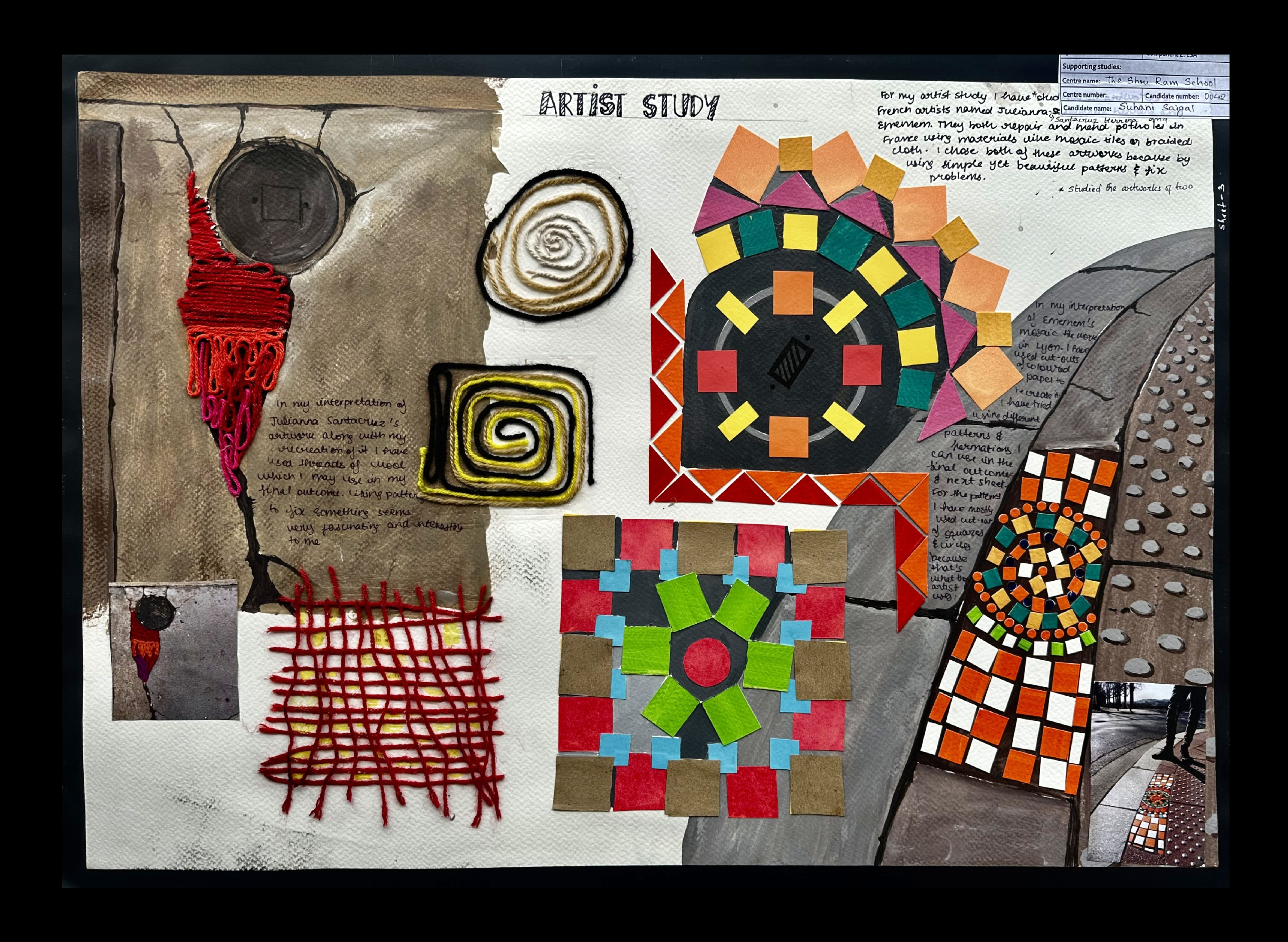
This sheet continues to explore ‘repair and mend’ by engaging with artists whose works resonated with my own experiences of fixing and restoring. On the left, I studied the works of Juliana Santacruz Herrera, recreating her stitched mends using wool and thread, layering spirals, weaving nets, and pairing them with a printed image of her work. Her transformation of broken pavements through colour and fibre, connecting with my earlier uses of yarn and patchwork, is visually grounding and personally meaningful. To contrast this, I studied French street artist Ememem, replicating his tiled interventions through layered paper cut-outs and symmetrical patterns. My final recreation blends a hand-rendered mosaic with a real photograph of his work, drawn into a street setting to reflect imagined and real repair. These studies allowed me to explore yarn and paper as symbolic tools of Jugaad, one intimate and soft, the other architectural and public.
SHEET -4


DETAIL WORK WITH WOOL AND STITCHING ON PAPER

COLLAGE DETAIL

DETAIL WORK WITH WOOL ON PAPER
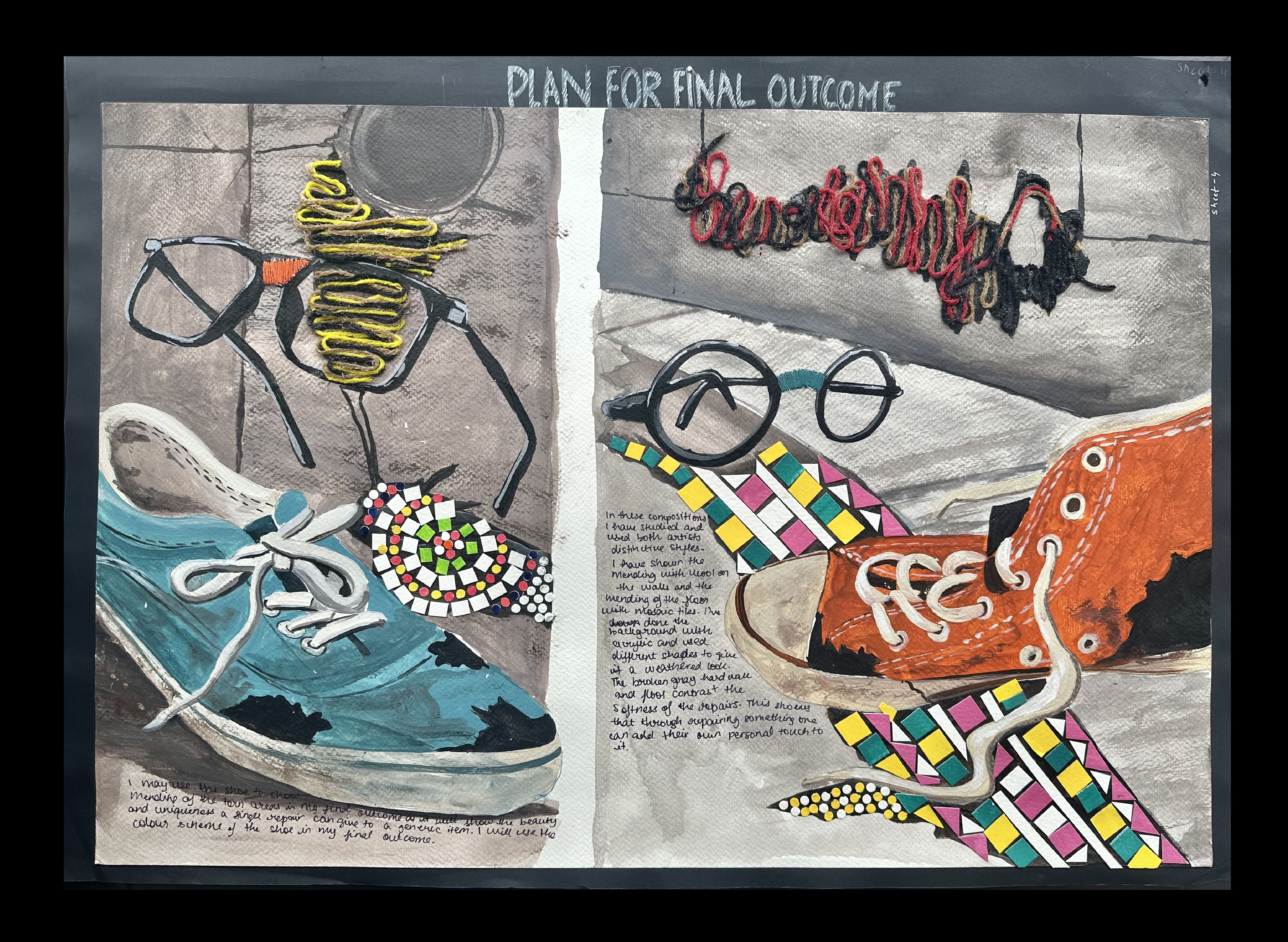
In these compositions, I’ve studied and applied the distinctive styles of both artists (Juliana Santacruz Herrera and Ememem) and showcased the concept of mending shoes, using cloth and acrylic. I painted the background in acrylic and added dark brown highlights to achieve a weathered texture, creating contrast that emphasizes the bright repairs. I chose the theme of a torn and mended shoe, as it’s an ideal object to represent repair. I used acrylic paint because its quick-drying properties allow for more efficient layering and detailed work. Integrating Juliana Santacruz’s wall art style alongside Ememem’s floor repair aesthetic in both panels creates a visual dialogue between the panels, as well as between the two styles of art.

Final exam

DETAIL WORK WITH WOOL ON PAPER

DETAIL WORK WITH STITCHING ON PAPER
In these compositions, I’ve studied and applied the distinctive styles of both artists (Juliana Santacruz Herrera and Ememem) and showcased the concept of mending shoes, using cloth and acrylic. I painted the background in acrylic and added dark brown highlights to achieve a weathered texture, creating contrast that emphasizes the bright repairs. I chose the torn and mended shoe, as it’s an ideal object to represent repair. I used acrylic paint because its quick-drying properties allow for more efficient layering and detailed work. Integrating Juliana Santacruz’s wall art style with Ememem’s floor repair aesthetic created a visual dialogue between surface and structure.